
China 中国
China is a nation with 5’000 years of History.
The People's Republic of China is run by a single party, the Chinese Communist Party (CCP), headed by the CCP General Secretary & President (Xi Jinping) of China.
China is the world's most populous country, with a population exceeding 1.4 billion, slightly ahead of India
China has the world's second-largest economy in terms of nominal GDP, and the world's largest economy in terms of purchasing power parity (PPP). As of 2021, China accounts for around 18% of the world economy by GDP nominal. China is one of the world's fastest-growing major economies, with its economic growth having been consistently above 6% since the introduction of economic reforms in 1978.
34 divisions including Taiwan. Classified as 23 provinces, 5 autonomous regions, 4 municipalities and 2 special administrative regions.
China legally recognises 56 distinct ethnic groups. The largest of these nationalities are the ethnic Chinese or "Han".
There is one nation, one political system but many different consumers, with different tastes & different types of needs.
Where should you get started?

Chinese city tier System

The Chinese city tier system refers to an unofficial hierarchical classification of Chinese cities in the People's Republic of China(PRC).
The Chinese City-Tier System is a classification of the 600+ cities that categorise into 4 different tiers (with “1” being the highest and “4” the lowest) according to different factors such as GDP, income level, administrative level, and population.
Many 2nd tier cities are considered as “new tier 1” thanks to their strong economical growth and purchasing power.
The system is useful for businesses and organizations when making decisions about investment, expansion, and marketing. The tiers are determined by several factors, including economic development, infrastructure, amenities, and population size.
The classification constantly changes and is always subject to debates.
10 largest cities of China are Shanghai, Beijing, Chongqing, Tianjin, Guangzhou, Shenzhen, Chengdu, Nanjing, Wuhan & Xi’an.
Where should you get started?
𝗖𝗵𝗶𝗻𝗮 𝗟𝗲𝗮𝗱𝘀 𝘁𝗵𝗲 𝗚𝗹𝗼𝗯𝗮𝗹 𝗟𝘂𝘅𝘂𝗿𝘆 𝗚𝗼𝗼𝗱𝘀 𝗠𝗮𝗿𝗸𝗲𝘁 𝗶𝗻 𝟮𝟬𝟮𝟰.
China dominates the global luxury market with 𝗨𝗦$𝟭𝟬𝟭.𝟳 𝗯𝗶𝗹𝗹𝗶𝗼𝗻 in revenue for 2024.
Accounting for 𝗮𝗻 𝗶𝗺𝗽𝗿𝗲𝘀𝘀𝗶𝘃𝗲 𝟮𝟭.𝟱% 𝗼𝗳 𝗴𝗹𝗼𝗯𝗮𝗹 𝗹𝘂𝘅𝘂𝗿𝘆 𝘀𝗮𝗹𝗲𝘀. China market is expected to grow annually by 𝟳.𝟬𝟴% (CAGR 2024–2029).
Notably, the largest segment is "𝗟𝘂𝘅𝘂𝗿𝘆 𝗪𝗮𝘁𝗰𝗵𝗲𝘀 & 𝗝𝗲𝘄𝗲𝗹𝗿𝘆," 𝗰𝗼𝗻𝘁𝗿𝗶𝗯𝘂𝘁𝗶𝗻𝗴 𝗻𝗲𝗮𝗿𝗹𝘆 𝟲𝟬% 𝗼𝗳 𝘁𝗵𝗲 𝘁𝗼𝘁𝗮𝗹 𝗿𝗲𝘃𝗲𝗻𝘂𝗲 𝗮𝘁 𝗨𝗦$𝟲𝟬.𝟲𝟵 𝗯𝗶𝗹𝗹𝗶𝗼𝗻.
Globally, the luxury market is valued at 𝗨𝗦$𝟰𝟳𝟯.𝟵 𝗯𝗶𝗹𝗹𝗶𝗼𝗻 in 2024, with projected annual growth of 𝟰.𝟬𝟰% (CAGR 2024–2029).
Other top markets include:
- USA: US$96.4 billion
- Japan: US$28.3 billion
- France: US$24.6 billion
-UK: US$18.6 billion
Chinese consumers continue to fuel not only their domestic market but also luxury purchases globally, contributing significantly to these figures.
While the Chinese economy may seem more sluggish recently, with growth slowing in other areas, 𝗖𝗵𝗶𝗻𝗮’𝘀 𝗹𝘂𝘅𝘂𝗿𝘆 𝗺𝗮𝗿𝗸𝗲𝘁 𝗿𝗲𝗺𝗮𝗶𝗻𝘀 𝘂𝗻𝗺𝗮𝘁𝗰𝗵𝗲𝗱 𝗮𝗻𝗱 𝗮 𝗸𝗲𝘆 𝗳𝗼𝗰𝘂𝘀 𝗳𝗼𝗿 𝗯𝗿𝗮𝗻𝗱𝘀 𝘄𝗼𝗿𝗹𝗱𝘄𝗶𝗱𝗲.
Source: Statista Luxury market B2C panel.

The rise of the middle class
According to data provided by the National Bureau of Statistics,
the size of China's middle-income group is now 400 million people, up more than 54 times from 7.358 million in 2002, making it the world's largest middle class population.
In terms of income, according to a report by the Brookings Institution, the Chinese middle class is defined as those with annual disposable incomes between 60,000 yuan (approximately $9,400) and 500,000 yuan (approximately $78,000) in 2020. This income range accounted for about 56% of urban households in China.
The size and purchasing power of the Chinese middle class have been steadily growing, contributing to the country's economic growth.
As of 2021, China's middle class accounted for 70% of the country's total household consumption, making it a significant driver of the economy.
Overall, the Chinese middle class is a key demographic for businesses looking to tap into the country's vast consumer market, and its growing affluence is likely to continue to shape China's economic and social landscape in the coming years.

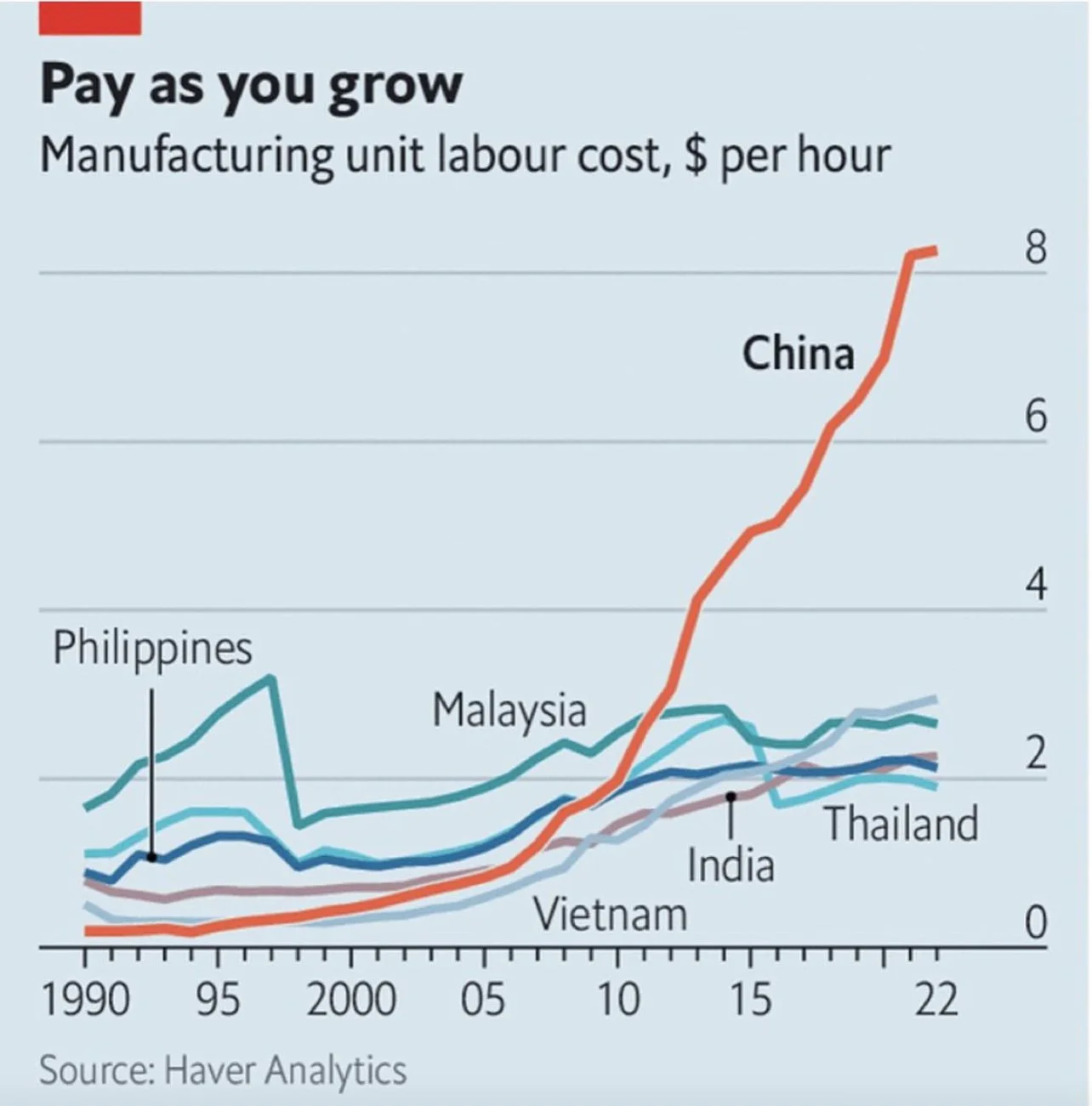
As of 2022, the manufacturing unit labor cost in China has risen to $8.28 per hour, marking a significant increase compared to the $2 per hour recorded in 2010.
This trend presents both opportunities for the growing middle class and challenges for the competitiveness of manufacturing costs in China.
The manufacturing labor cost per hour in China is influenced by various factors such as location, industry, skill level, and company-specific practices. Labor costs can significantly differ across regions, with coastal areas and major industrial centers generally having higher labor expenses than inland or less developed regions. In certain areas, the labor cost remains estimated at around $3 to $5 USD per hour.
It is important to recognize that labor costs in China have been progressively rising, prompting the country to transition towards more advanced and value-added manufacturing sectors. This shift reflects China's evolving economic landscape and its pursuit of higher-quality production.
China’s Imports & Exports
In 2022, China's trade dynamics remained robust, with imports totaling $2.71 trillion and exports reaching $3.59 trillion, resulting in a substantial trade surplus of $878 billion.
Unsurprisingly, the United States emerged as China's largest customer, importing an impressive $582 billion worth of goods and services from China in 2022.
China's pivotal role in global trade is evident as numerous multinational corporations, including industry giants like Apple and Tesla, heavily rely on China to support their manufacturing operations.
In 2021, China solidified its position as the trade leader, boasting a trade surplus of $463 billion. In stark contrast, the United States holds the title for the largest trade deficit globally, which stood at -$845 billion. Notably, the United States' trade deficit is more than ten times the magnitude of the next-largest deficit belonging to India.
Given this context, it is unsurprising that trade wars and political tensions have arisen between the United States and China.
